Saturday, March 1, 2025
Red Sox in Cooperstown Pt. 48: Billy Wagner
Saturday, January 25, 2025
Red Sox in Cooperstown Pt. 47: Adrian Beltre
Adrian Beltre is the greatest One Year Wonder in Red Sox history. I have done exhaustive posts on these things, I know what I am talking about. He may be one of the greatest One Year Wonders for any team's history. Juan Soto's Yankees stint is probably better, but I can't think of too many others. Beltre came up with the Dodgers as a young phenom at the age of 19 and spent the first six years in L.A. He had some good years, but suffered from some injuries. He just never quite seemed ready to break out. Until 2004.
2004 was Beltre's last year in L.A. and he went out on a high note. That year, he leveraged a .334/.338/.629 line into a lucrative free agent deal with the Mariners. He led the league with 48 home runs and drove in 121. He finished second in the MVP race and won his first Silver Slugger. Unfortunately, he was not able to keep up that production in Seattle, largely because the park was ill-suited to his swing. He never hit more than 26 home runs or higher than .276. He did cement a reputation as a top defensive third-baseman though, winning two Gold Gloves during his time in the Emerald City.
By the end of the 2009 season, Beltre's star was waning. He signed a one-year deal after the offseason with the Red Sox. That year though, he completely turned his career around. He put up phenomenal numbers and found Fenway Park to his liking. He led the league with 49 doubles and had his best season since 2004 finishing among the league leaders in average, RBIs and slugging. He was named to his first All Star Game (somehow he was not an All Star in 2004), won his second Silver Slugger and finished ninth in the MVP race.
Unfortunately the Red Sox long coveted another Adrian and eventually let Beltre walk as a free agent. The team traded for Adrian Gonzalez, moving Kevin Youkilis back to third base and there was no room for Beltre. This would turn out to be a mistake as Beltre continued his resurgence in Texas. He was named to the All Star team four more times and won four Silver Sluggers and three Gold Gloves and eventually made it to 400 career home runs and 3,000 career hits.
In 2024, Beltre made it to the Hall of Fame on his first ballot, and it was well-deserved. He goes down as one of the greatest all-around third-basemen in baseball history. He wears a Rangers cap on his plaque, which absolutely makes sense, but his stint in Boston was important because it turned his career around. He was floundering after leaving Seattle, but found his stroke again in Boston and kept it up through the end of his career.
Wednesday, December 20, 2023
Red Sox in Cooperstown Pt. 46: Eddie Collins
As I am reading a book about the Hall of Fame and also watching as ballots come in for next year's induction, I was reminded that I forgot someone when doing my Red Sox in Cooperstown posts. Eddie Collins, the great second-baseman with the Philadelphia Athletics and Chicago White Sox from 1906 through 1930 never played for the Red Sox, but he did serve as general manager of the team for several years. And yes, that card is listed as a Red Sox card.
When Tom Yawkey purchased the Red Sox he wanted to hire someone to run the team that was a baseball man and understood what types of players to bring in. He also idolized Collins from his playing days, so it was a no-brainer that he would bring Collins in to make the personnel decisions. Yawkey opened up his checkbook to the advice of Collins and brought in stars such as Rick Ferrell, Joe Cronin, Lefty Grove and Jimmie Foxx. Collins also had input into the development of young players which led to Bobby Doerr and Ted Williams, among others.
Under Collins and Yawkey, the Red Sox were transformed from perpetual bottom dwellers to a dangerous team that eventually made it to the World Series in 1946. Unfortunately, Collins's health was declining at the time and he retired after 1947.
Of course it was not all good under Collins. There is the obvious issue of the farce that was the Jackie Robinson tryout in 1945. Collins has been accused of being one of the individuals responsible for Boston not integrating, although that may not be entirely fair. For one thing, at the time of his retirement, only three out of sixteen teams had integrated. For another, Collins did bring in the first Mexican-born Major Leaguer, Mel Almada. It is difficult to say what, if any, blame Collins deserved in Boston failing to integrate before 1959. He certainly did not sign Robinson when he had a chance, but he was not around much longer after that to see if he would change things or not.
Monday, June 19, 2023
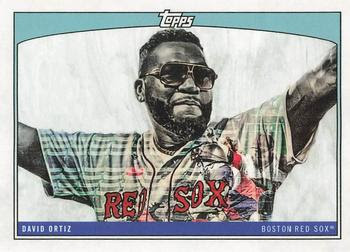
Red Sox in Cooperstown Pt. 45: David Ortiz
David Ortiz has to be one of the single greatest free agent bargains in the history of the game. Ortiz was originally signed by the Seattle Mariners as an international free agent and rose through the same system that produced Alex Rodriguez around the same time. But in September of 1996, he was sent to the Minnesota Twins as a player to be named later in the deal that brought Dave Hollins to the Mariners. The Mariners in those days made a lot of silly moves.
Ortiz spent the next six seasons with the Twins, but only twice played in more than 100 games. His power was evident as he hit 58 home runs during this time period, with a high of 20 in 2002, but the Twins wanted him to become something he was not. The Twins thought that they could turn him into a contact hitter with occasional home run power. After several seasons of attempting this, they decided to cut bait and non-tendered him in December of 2002. Ortiz was on the market for a little while until Pedro Martinez contacted Red Sox management and put in a good word for him. He was signed shortly thereafter for $1 million.
2003 would be the turning point in Ortiz's career, but it did not start off real promising. The Red Sox had brought in a number of hitters who kind of clogged up the first base and designated hitter spots, including Kevin Millar and Jeremy Giambi. In addition, they had to find playing time for two third-basemen in Shea Hillenbrand and Bill Mueller. So Ortiz struggled to get playing time for the first few months. Eventually though, Hillenbrand was traded for relief help and Giambi's struggles made it easy to move on from him. Ortiz found himself the primary designated hitter. He did not let this opportunity pass him by as he hit .288/.369/.592 with 31 home runs and 101 RBIs, leading to a fifth place MVP spot.
The next season was when Ortiz became a legend. He showed his 2003 season was not a fluke by hitting .301/.380/.603 with 41 home runs and 139 RBIs, making his first All Star team. Then, he showed his incredible ability to hit in the clutch in the postseason. First was the walkoff home run that sent the Angels home in the ALDS. Then, he hit a stunning walkoff home run against the Yankees in Game 4 of the ALCS. It was a must-win game for the Red Sox after being down 3-0 in the series and having just tied the game off of Mariano Rivera in the ninth. He was not done though and hit a walkoff single in Game 5. Ortiz hit .387 with three home runs and 11 RBIs in the ALCS win and was named the MVP. He also homered in the World Series against the Cardinals.
From 2003 through 2007, Ortiz finished in the top five in the MVP balloting every season, finishing as high as second in 2005. He led the league in RBIs twice, home runs once and walks once during this time period. He set the team's single season record for home runs in 2006 with 54, surpassing Jimmie Foxx's nearly seventy-year old record of 50. During this time period he helped the Red Sox to another World Championship in 2007.
In 2008, some cracks began to appear. He got off to a very slow start and only ended up hitting .264 with 23 home runs and 89 RBIs. 2009 saw his batting average dip all the way to .238, but he hit 28 home runs and drove in 99. There were concerns that he was waning, but he rebounded somewhat in 2010, hitting .270 with 32 home runs and 102 RBIs. He was rejuvenated after that, suffering some minor injuries but staying mostly in line.
2013 was Ortiz's third World Championship season. In the regular season, he was once again an All Star and won the Silver Slugger while finishing tenth in the MVP voting. He hit .309/.395/.564 with 30 home runs and 103 RBIs. Then, he reminded the baseball world of his clutch hitting ability in the postseason. He hit two home runs off of the Rays in the ALDS. He did not do much in the ALCS against the Tigers except for one at-bat that may be one of the greatest at-bats in postseason history. Boston had struggled against the exceptional pitching of the Tigers in Game 1 and it was getting late in Game 2 when Ortiz came to the plate with the bases loaded in the eighth against Joaquin Benoit down 5-1. He sent a Benoit pitch (who he had never homered against previously) into the bullpen, along with a chasing Torii Hunter to tie the game and provide the turning point in the series.
In the 2013 World Series, Ortiz was other-worldly. The Cardinals tried to pitch to him early on, but he was crushing everything. Even his outs were hit hard. Eventually, they just stopped pitching to him altogether. Ortiz ended up that World Series with a line of .688/.760/1.188 with two home runs and six RBIs to lead Boston to the title. He was an easy choice for World Series MVP.
Ortiz's average dipped again in the next two seasons, but his home runs and RBIs remained at a high level and he eventually hit his 500th career home run. He announced prior to the 2016 season that he would retire at the end of the year and it became his victory lap. Teams lavished gifts on him throughout the season while he continued to wear out their pitchers. He had what was probably one of his greatest seasons, hitting .315/.401/.620 with 38 home runs. He led the league in slugging percentage, doubles (48, not bad for an old guy), RBIs (127) and OPS (1.021) and was an All Star and won the Silver Slugger while finishing fifth in the MVP vote. Unfortunately Boston was bounced in the first round of the postseason and could not win one last time for the big guy. Ortiz took to the field shortly after the last out at Fenway and tearfully waved goodbye one last time as an active player.
Ortiz's legacy is as an incredible clutch hitter who helped lead Boston to three World Championships, almost unheard of prior to his arrival (Harry Hooper has four, but that was 100 years ago). He was an All Star ten times, won seven Silver Slugger Awards, was a Home Run Derby Champ and won the MVPs in both the ALCS and World Series. He finished in the top five of league MVP voting five times. He hit 541 career home runs, including 483 with the Red Sox, which is more than any other player not named Ted Williams. Ortiz is a Red Sox icon and he was one of the faces of the game for many years. There was some concern about his candidacy for the Hall of Fame, but when the voting was announced, he made it in with some room to spare. Some writers did not vote for him because he was a designated hitter for the great majority of his career, others were convinced he used PEDs, though there was little, if any, proof of that. When it all came down to it though, Ortiz marched into the Hall of Fame wearing a Red Sox cap.
Sunday, June 4, 2023
Red Sox in Cooperstown Pt. 44: Lee Smith
Lee Smith was a monster. A hulking 6'5", 220 lb. reliever from Louisiana, he was an intimidating force in the late innings. After spending the first eight seasons of his career with the Cubs, saving 180 games and striking out 644 batters in 681.1 innings, he was traded to the Red Sox. The price was Al Nipper and Calvin Schiraldi, two pitchers Boston did not really even need at that point. Nipper was coming off of an 11 win season, but had an ERA nearly 6, and Schiraldi was not the same pitcher after his collapse in the 1986 postseason. It is easy to say Boston won this deal.
Smith solidified the back end of the Red Sox bullpen for the next two full seasons. He saved 29 games in 1988 and then 25 in 1989. His ERA in 1988 was 2.80 and he had a 4-5 record with 96 strikeouts. His ERA increased to 3.57 the next season, but he had a record of 6-1 while again recording 96 strikeouts, this time in just 70.2 innings. Smith was not an All Star in either season, primarily due to the emergence of Dennis Eckersley as an automatic game-ender in Oakland. He did receive some down-ballot MVP votes in 1988 though.
The 1990 season started off a bit strange. For some reason, Boston signed closer Jeff Reardon to a free agent deal. Whether the intention was to split the duties between the two or have one or the other close was not clear. Smith pitched in just 11 games into May, but made them count. He had a record of 2-1 with a magnificent 1.88 ERA while notching four saves. He struck out 17 in 14.1 innings. Then, he was traded to the Cardinals. Boston needed more offense and had two closers when most teams only have one, so Smith was jettisoned for Tom Brunansky. Bruno did not quite provide the offense expected. The former 30 home run hitter never hit more than 16 in Boston. Smith on the other hand evolved into a Hall of Fame-worthy closer.
Over the next few years, Smith was an All Star five times and led the league in saves three times, primarily with the Cardinals. He also made stops with the Yankees, Orioles, Angels, Reds and Expos before retiring. When he retired, he held the all-time saves record with 478. It took Smith a long time to get into the Hall of Fame. He was on the ballot with the BBWAA for 15 years before finally gaining induction through the Eras Committee on his first attempt.
Smith wears a Cubs hat on his plaque and that is the team he spent the longest amount of time with, though his legacy seemed to have really been cemented during his time with the Cardinals. I thought it could have gone either way between those two teams. His time in Boston was the third-longest stretch, but there were no individual achievements to distinguish it otherwise. He was just a solid closer during that time. It is certainly important to his story, but was more of a stepping stone between his more noteworthy stints with the Cubs and Cardinals.
Sunday, April 16, 2023
Red Sox in Cooperstown Pt. 43: Tom Yawkey
Tom Yawkey owned the Boston Red Sox for 44 years, longer than any other owner in team history. He was beloved by his players and was popular among the fans and media. As the years have gone on though, his legacy has become more clouded with revelations about his potential involvement in the team's inability to integrate in the 1940's and 1950's. The street that was once named after him in front of Fenway Park has been renamed as the team has tried to distance itself from Yawkey.
Yawkey likely deserves at least some of the criticism for not integrating earlier. He was the owner after all and could have forced the issue. He also likely should be criticized for being unable to field a championship team. The Red Sox contended for much of Yawkey's ownership, but only made the World Series three times, each time losing in seven games. Had the team been able to strike a better balance between player development and bringing in big stars, they may have won more. The team though often seemed to be in one phase or the other, and almost never both. When Yawkey first bought the team, the team had very few good players and no real farm system. Yawkey resorted to buying players from teams that were struggling financially. By the 1940's the team was developing its own stars, but not spending as much on outside talent, and in particular, did not have enough pitching. Then the 1950's saw the Red Sox try, but largely fail, to develop good players, and this was where not bringing in the talented black players hurt the team the most. There was a massive influx of talent as other teams signed players from the Negro Leagues, but Boston, for whatever reason, did not get involved. The team finally started to come back around in the late 1960's and early 1970's when Yawkey brought in GM Dick O'Connell, who had a clear plan. The team fought its way back into contention with some of the most balanced rosters they ever had under Yawkey's ownership. Yawkey though, died in 1976, never achieving his dream of seeing the Red Sox win the World Series.
As I said, there is a fair amount to criticize about Yawkey. But one thing is clear: if not for Yawkey, the Red Sox may not still exist. When Yawkey took over the team, the Red Sox had been a bottom-dwelling team for more than a decade. Since 1919, the team was more known selling its only good players away than for anything it did on the field. Yawkey put an end to that, fixed up Fenway Park, and brought good players in. He essentially saved the franchise from oblivion. And for that, he does deserve to be remembered.
Yawkey has an extremely complicated legacy. He was elected to the Hall of Fame by the Veterans Committee. I think it is safe to say that if he was eligible today, he likely would not be elected, but that does not mean that his election was unwarranted at the time. I really cannot say whether he should have been elected or not. I do not think there is any clear standards for executives to be elected to the Hall of Fame. Yawkey revitalized an organization and ran it for 44 years. That cannot really be said of that many other executives in the Hall.
Thursday, March 23, 2023
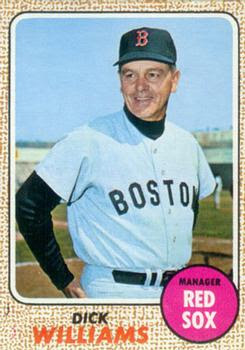
Red Sox in Cooperstown Pt. 42: Dick Williams
Williams would go on to manage through the 1988 season. He served stints with the Athletics, Angels, Expos, Padres and Mariners. He won the World Series with the Athletics in both 1972 and 1973. He also led the Padres to the World Series, but lost to the Tigers, in 1984.
Tuesday, March 14, 2023
Red Sox in Cooperstown Pt. 41: Billy Herman
Tuesday, December 7, 2021
Red Sox in Cooperstown Pt. 40: Bucky Harris
Years in Boston: 1934 (76-76)
Best Year in Boston: 1934 (76-76)
Saturday, September 7, 2019
Red Sox in Cooperstown Pt. 39: Joe McCarthy
Joe McCarthy is in the Hall of Fame exclusively because of his managerial career. He was not much of a player and did not even make the Major Leagues. But he was one hell of a manager. He started out managing the Chicago Cubs for five years. In that time period, his teams never lost more than they won and he led them to the World Series in 1929 where they lost to the Philadelphia Athletics. He was fired toward the end of the 1930 season and then joined the Yankees the next year where he enjoyed an unparalleled level of success.
McCarthy was the Yankees' manager from 1931 through 1946. He saw the ends of the careers of Babe Ruth and Lou Gehrig and the bulk of the Joe DiMaggio career. His teams were an absolute juggernaut, going to eight World Series, and winning seven of them. He retired as the winningest manager in Yankees' history. He is still yet to be surpassed. He lost his job in 1946, but was not unemployed long. He signed on to manage the Boston Red Sox after a year away.
The Red Sox were also a terrific team during McCarthy's tenure. In his first season, the Red Sox tied the Cleveland Indians for the American League lead during the 144-game regular season. A one-game playoff was ordered. But for some reason, McCarthy decided to start journeyman pitcher Denny Galehouse in the game instead of one of his aces, Mel Parnell or Joe Dobson. Galehouse was roughed up early and Boston fell way behind. It was a terrible decision.
The next season, the Red Sox finished with the exact same record as they did the year before (minus the one-game playoff), but again missed the World Series. The problem this time was a close race with the Yankees. Entering the final two games of the season, Boston needed to beat New York just one time to win the pennant. Unfortunately, due to more managerial blunders, they lost both games. Part of the problem was due to a lack of pitching. Parnell and Ellis Kinder basically pitched everyday down the stretch.
The 1950 season started strong, but the lack of pitching and McCarthy's drinking eventually did him in. McCarthy retired for good. He still boasts the highest all-time winning percentage as a manager. With Boston, his winning percentage was .606.
McCarthy was elected to the Hall of Fame in 1957. He wears a Yankees' cap on his plaque. He certainly managed some good teams in Boston, but his inability to win it all is a black mark on his career. His tactics were simply not good enough to win in Boston. He will always be remembered as a Yankee.
Sunday, August 18, 2019
Red Sox in Cooperstown Pt. 38: Hugh Duffy
Years in Boston: 1921-1922 (136-172)
Best Year in Boston: 1921 (75-79)
Like the last post in this series (Frank Chance), Hugh Duffy is far more known for his playing career than his managerial career and it is his managerial career that brought him to the Red Sox. Duffy spent 17 seasons in the Majors and had his best seasons prior to the 20th century. He nearly won the Triple Crown as an outfielder for the Boston Beaneaters (later, the Braves) in 1894 when he hit .440/.502/.694 with 18 home runs and 145 RBIs. He was something of a slugger of the time period, hitting double digits in home runs three times.
Duffy was a player/manager for a few years late in his career, but was mostly out of Major League baseball after 1911. The Red Sox hired him to be their manager in 1921 and he inherited a team that had lost a ton of talent to the New York Yankees. The 1921 team still had Herb Pennock, Bullet Joe Bush and Everett Scott and had just acquired Del Pratt. That team was not terrible, finishing four games under .500, which was an improvement from the prior season. Hopes were high.
Unfortunately, the team jettisoned more talent going into 1922, shipping away Bush, Scott and Stuffy McInnis. New acquisitions were Jack Quinn and George Burns. Despite a few decent seasons from Burns, Pratt and Joe Harris, the pitching was in shambles and the team finished 61-93. That was it for Duffy as manager. Duffy though remained in the Boston organization, mostly as a scout until 1953. He died in 1954.
Duffy's time with the Red Sox is largely irrelevant to his presence in Cooperstown. He was not a successful manager and his career as a scout is mostly a footnote.
Tuesday, February 5, 2019
Red Sox in Cooperstown Pt. 37: Frank Chance
Years in Boston: 1923 (61-91)
Best Year in Boston: 1923 (61-91)
Somehow, I do not own that card. Frank Chance was part of the legendary Cubs Hall of Fame double play combo immortalized in "Baseball's Sad Lexicon" of Tinker to Evers to Chance. Chance became the Cubs' player-manager in 1905 and continued in that role through the 1912 season. He then continued this role with the Yankees for the next two seasons, though his playing time was greatly diminished. In 17 seasons in the Majors, Chance hit .296/.394/.394 and stole 403 bases.
After the 1914 season, Chance stayed in baseball, but managed and was an executive for Pacific Coast League teams. Somehow, he returned to the Majors to manage the Red Sox in 1923. This was not a good Red Sox team. The team finished 61-91 and had very few decent players. Almost all of the good Red Sox players had already been sold or traded, most of them to the Yankees. Joe Harris was the team's leading hitter, and Ira Flagstead and George Burns were also good players. Howard Ehmke won 20 games and Jack Quinn was a decent number two starter. Things were not as bleak as they would be later in the decade.
Chance only signed a one-year deal to manage the Red Sox. He returned to Chicago to manage the White Sox in 1924, but came down with influenza before the season began. He died later in the year.
Frank Chance only spent one season in Boston as a manager. He is in the Majors almost entirely due to his time with the Cubs as player and manager. All three of the double play trio were eventually enshrined in Cooperstown in 1946. It is fair to say that Chance's time with the Red Sox was an afterthought in his career.
Monday, December 3, 2018
Red Sox in Cooperstown Pt. 36: Ed Barrow
Years in Boston: 1918-1920 (213-203)
Best Year in Boston: 1918 (75-51, World Championship)
Ed Barrow is not in the Hall of Fame due to his time as a manager. Barrow was a manager for just five years, two with mediocre teams in Detroit from 1903-1904 and five with mostly mediocre teams in Boston from 1918-1920. He did win a World Championship with the Babe Ruth-led Red Sox in 1918 though, which is something like a necessity to get in the Hall of Fame as a manager. No, Barrow is in the Hall of Fame due to his time as the primary architect of the great Yankees teams of the 1920's to the 1940's. Of course a lot of that was at the expense of the Red Sox, who Barrow plundered mercilessly. So this is not exactly a positive inclusion for the Red Sox.
But enough of the bad stuff. There were a few good things that Barrow did for the Red Sox during his time as manager. For one, of course, there is the World Championship that he won in 1918, his first season with the Red Sox. That team was primarily led by pitching and defense. Ruth was the biggest star on the team by a huge margin. Harry Hooper was still with the team and was a terrific player, and eventual Hall of Famer. On the pitching side, they had Carl Mays, Bullet Joe Bush, Sad Sam Jones, Dutch Leonard, and of course Ruth.
The other big positive he brought to the Red Sox was converting Babe Ruth into a position player. 1918 was the year this really became a possibility. Ruth pitched in just 20 games that year, but also 59 games in the outfield and 13 at first base. This would of course have the eventual consequence of Ruth becoming quite possibly the greatest player of all time.
So Barrow was not in Boston long, and the primary reason for his inclusion is for building up the Yankees, but he did bring two things to the Red Sox that will be remembered.
Saturday, November 3, 2018
Red Sox in Cooperstown Pt. 35: John Smoltz
Years in Boston: 2009 (2-5, 8.33 ERA, 33 strikeouts, 9 walks, 40 innings pitched)
Best Year in Boston: 2009 (2-5, 8.33 ERA, 33 strikeouts, 9 walks, 40 innings pitched)
This is a somewhat timely post as Smoltz was one of the primary announcers during the Red Sox run through the 2018 World Series. He came off fairly curmudgeonly and bitter.
Smoltz was nearing the end of his career when he signed a free agent deal with the Red Sox before the 2009 season. He was 42 years old and coming off of a season in which he pitched in just eight games. This was his first time wearing a Major League uniform for a team other than the Atlanta Braves for whom he had won 210 games, saved 154, and struck out over 3,000 batters.
Things did not work out well for Smoltz in Boston unfortunately. He pitched in just eight games with an awful 2-5 record and an 8.33 ERA. His control was decent as he struck out 33 and walked just nine in 40 innings.
The Red Sox cut ties with Smoltz in August of 2009 and he hooked on with the Cardinals to finish out the year, and his career. He made an appearance in the postseason with St. Louis. Smoltz's time in Boston was brief and not at all successful. Smoltz was elected to the Hall of Fame in 2015, his first year on the ballot. He wears a Braves cap on his plaque. There was no way in hell he was going to be wearing a Red Sox cap.
Friday, September 21, 2018
Red Sox in Cooperstown Pt. 34: Rickey Henderson
Years in Boston: 2002 (.223/.369/.352, 5 home runs, 16 RBIs, 8 stolen bases)
Best Year in Boston: 2002 (.223/.369/.352, 5 home runs, 16 RBIs, 8 stolen bases)
Rickey Henderson was the reigning AL MVP when I first started watching baseball. He was a completely different player than anyone on the Red Sox at that time, a player who had just broken the career stolen bases record and would go on to tack on nearly 500 more before he finally retired.
By the time he came to Boston, he was well past his prime and was 43 years old. He was not expected to be a starter, just a helpful player off the bench. He had already broken the career runs record and recorded his 3,000th hit.
Henderson played in just 72 games, but he got on base at an impressive pace, particularly since his batting average was just .223. He stole eight bases to add to his Major League record. He spent most of his time in left field, but appeared in a few games at designated hitter and, oddly, in center field for the first time in several seasons.
Henderson was already well on his way to the Hall of Fame by the time he played in Boston. He merely added some numbers to his Cooperstown credentials. He played one more season after leaving Boston, finishing his Major League career with the Los Angeles Dodgers in 2003. Henderson played with the Athletics, Yankees, Blue Jays, Padres, Angels, Mariners, Mets, Red Sox, and Dodgers. He is wearing an Oakland hat on his Hall of Fame plaque.
Tuesday, July 24, 2018
Red Sox in Cooperstown Pt. 33: Pedro Martinez
Years in Boston: 1998-2004 (117-37, 2.52 ERA, 1,683 strikeouts)
Best Year in Boston: 1999 (23-4, 2.07 ERA, 313 strikeouts)
Oh man, Pedro Martinez. What a terrific pitcher he was, quite possibly one of the most dominant starting pitchers I have ever seen. Every game he pitched in Boston was an event. He was simply incredible. And the greatest thing about him was that he was doing this in the Steroid Era.
Martinez came up in the Dodgers system, like his brother Ramon, before being traded to Montreal for Delino DeShields, a trade that did not work out well for Los Angeles. He became an All Star with the Expos and won his first Cy Young Award in 1997. After the season, Montreal dealt him to Boston for a couple of pitching prospects: Carl Pavano and Tony Armas, Jr. The deal did not work out great for Montreal either.
Boston, on the other hand, got a great pitcher in his prime. 1998 saw Martinez finish second in the Cy Young vote to former Red Sox Roger Clemens with a 19-7 record, 2.89 ERA, and 251 strikeouts. But in 1999, he became the legendary dominant force at the top of the Red Sox rotation. That season he was a unanimous selection as the Cy Young Award winner and finished second in the MVP vote as well. I still think he should have won it. He won the pitching Triple Crown by leading the league in wins (23), ERA (2.07), and strikeouts (313, a team record). He was the All Star Game MVP that season when he struck out five of six batters he faced in the first two innings. He was also electrifying in the postseason, coming on in relief in the decisive Game 5 of the ALDS against the Indians with six no-hit innings, and winning his only start against the Yankees in the ALCS.
He might have been even better in 2000. He was again a unanimous Cy Young winner, going 18-6 with an incredible 1.74 ERA and 284 strikeouts. Unfortunately, Martinez missed a significant chunk of the 2001 season and only pitched in 18 games, going 7-3 with a 2.39 ERA and 163 strikeouts. He made a complete comeback in 2002 though, going 20-4 while leading the league with a 2.26 ERA and 239 strikeouts, and probably should have won the Cy Young Award again. 2003 was Martinez's last great season with Boston as he went 14-4 with 206 strikeouts and a league-leading 2.22 ERA.
Martinez was becoming ever more injury-prone as the seasons wore on. He entered the 2004 season, the last under his seven-year deal with Boston, as no longer the sole focus in the rotation. The Red Sox had acquired Curt Schilling in the offseason and Schilling was getting a lot of attention. Martinez was no longer dominating in 2004, he was just very good. He finished his final season in Boston at 16-9 with an un-Pedro-like 3.90 ERA. He did strike out 227 batters though.
Pedro Martinez left the Red Sox a World Champion though. He pitched well in one game against the Angels in the ALDS, but had some trouble with the Yankees in the ALCS. His final game in a Red Sox uniform came in Game 3 of the World Series against the Cardinals. He pitched seven strong innings, giving up just three hits and two walks while striking out six and winning. After the season, Martinez moved on to the Mets and had one last great season before injuries started really taking their toll on his career.
Martinez was elected to the Hall of Fame in his first attempt in 2015. He wears a Red Sox cap on his plaque. Boston fans were lucky to be able to see him in his prime and his Red Sox career consists of two Cy Young Awards, four All Star appearances, an All Star Game MVP, and a World Championship ring.
Tuesday, April 25, 2017
Red Sox in Cooperstown Pt. 32: Andre Dawson
Years in Boston: 1993-1994 (.260/.297/.441, 29 home runs, 115 RBIs)
Best Year in Boston: 1993 (.273/.313/.425, 13 home runs, 67 RBIs)
I was heartbroken in the offseason between the 1992 and 1993 seasons when Wade Boggs, my favorite player, signed as a free agent with the Yankees. That was alleviated significantly when the Red Sox signed a fading future Hall of Famer of their own in Andre Dawson, who had been with the Chicago Cubs for the previous several seasons. Boston had been trying to sign Kirby Puckett, who was still very productive, but Puckett ultimately chose to stay in Minnesota. Dawson had a decent, but not great season with the Cubs in 1992 and there was hope that his power numbers would rebound in Boston.
Unfortunately, Dawson was largely a disappointment in Boston. His knees were so bad by that point in his career he spent all but 20 games at designated hitter. That was mostly the plan though, so that part was not the major disappointment. Dawson simply did not hit enough. He had never been great about taking a walk, but his on-base percentage in his time in Boston was significantly lower than his career mark and even his slugging percentage was down.
In 1993, Dawson hit .273/.313/.425 with just 13 home runs and 67 RBIs, numbers that were significantly lower than hoped. He played in 121 games and hit 29 doubles. His biggest highlight of the year, and of his time with Boston was hitting his 400th career home run. In 1994, his numbers declined again, though he hit 16 home runs. He hit .240/.271/.466, with 18 doubles and 48 RBIs.
After the 1994 season, Dawson signed a free agent deal with the Florida Marlins and closed out his career after two seasons on the bench there. Dawson's best years occurred in Montreal and Chicago by far. He was mostly just hanging on by the time he played for Boston and Florida. The one thing he did provide in Boston was veteran leadership and guidance for up-and-coming star Mo Vaughn. Dawson was on the Hall of Fame ballot for nine years before being elected. He has a Montreal Expos cap on his plaque.
Tuesday, March 14, 2017
Red Sox in Cooperstown Pt. 31: Tom Seaver
Years in Boston: 1986 (5-7, 3.80 ERA, 72 strikeouts, 104.1 innings)
Best Year in Boston: 1986 (5-7, 3.80 ERA, 72 strikeouts, 104.1 innings)
1986 was the final season of Tom Seaver's illustrious career. "Tom Terrific" was one of the greatest pitchers of all time. He was a 12-time All Star, a Rookie of the Year, and a three-time Cy Young Award Winner. He was also 41 years old and was running out of gas.
Seaver started the 1986 season with the Chicago White Sox, his third team in his career. He had been with the ChiSox since signing as a free agent prior to the 1984 season. He was coming off of a season in which he had gone 16-11 with a 3.17 ERA and 134 strikeouts in 238.2 innings. He had also won the 300th game of his career in 1985. So he still had something left in the tank coming into the 1986 season, but he had a pretty rough start to the season.
Through 12 starts for the White Sox, Seaver was 2-6 with an uncharacteristically high 4.38 ERA in 72 innings. He was also walking nearly as many (27) as he was striking out (31). So it looked like age was finally catching up to him. Nevertheless, the Boston Red Sox, who were contending for the AL East division title, needed some pitching depth after some off-the-field issues with Oil Can Boyd, and swung a deal with the White Sox to acquire Seaver in exchange for young outfielder Steve Lyons. Seaver turned his season around and finished strong.
Seaver turned in a fairly decent 16 games for the Red Sox to close out his career. He had a record of 5-7 with a 3.80 ERA but provided valuable innings and improved his strikeout to walk ratio markedly. He struck out 72 and walked just 29 in 104.1 innings for the Red Sox. He had his best game in an August outing against the Tigers when he pitched a complete game five-hitter, giving up just one run while striking out nine and walking only one.
Unfortunately, Seaver was unable to pitch in the postseason as he went down with an injury. He missed a chance to pitch against the team he is most associated with, the New York Mets, in the World Series. Seaver attempted a final season in 1987 back with the Mets, but ended up retiring. Though his time with the Red Sox was brief and did not add much to his final numbers, he was reasonably successful.
Tuesday, February 21, 2017
Red Sox in Cooperstown Pt. 30: Wade Boggs
Years in Boston: 1982-1992 (.338/.428/.462, 85 home runs, 687 RBIs, 2,098 hits)
Best Year in Boston: 1987 (.363/.461/.588, 24 home runs, 89 RBIs, 200 hits)
And now we come to one of my all-time favorite players. Boggs was my first favorite player when I started watching baseball in the early 1990's. It helped that he was born in Omaha, Nebraska, though he actually grew up in Florida. Boggs had a rough path to the Majors. He was drafted in the seventh round and was never considered a top prospect, despite hitting at every stop in the minors. It took several years before he made it to the big leagues because he was not a power hitter and he struggled defensively at third base. Boston also had Carney Lansford at third basem, who won a batting title in 1981.
Saturday, February 4, 2017
Red Sox in Cooperstown Pt. 29: Tony Perez
Years in Boston: 1980-1982 (.266/.318/.443, 40 home runs, 175 RBIs, 126 runs, 289 hits)
Best Year in Boston: 1980 (.275/.320/.467, 25 home runs, 105 RBIs, 73 runs, 161 hits)
Tony Perez had a long 23-year career. He spent 16 of those years with the Cincinnati Reds and that is the team with whom he will be forever identified. His first 13 seasons and his last three were spent with the Reds, book-ending seven seasons with the Expos, Red Sox, and Phillies. He rose to prominence with the Reds and was a key member of the Big Red Machine teams that won the 1975 and 1976 World Championships. He was named to seven All Star teams during his career, all of which were with the Reds. Of course, this post is about his time with the Red Sox.
After three decent seasons with the Expos, Tony Perez signed a free agent contract to join the Boston Red Sox in November of 1979. His time with Boston was the only time he played in the American League. The Red Sox had an opening at first base after Bob Watson, who had been acquired to take over for the traded George Scott, signed as a free agent with the Yankees. Perez was about to turn 38 early in the 1980 season, but he still had something left in the tank, at least at first.
Perez spent the vast majority of the 1980 season at first base, with just a dozen games at designated hitter. He was never a very good defensive first-baseman. He did not have a ton of range, and he made ten errors in 1980. Nevertheless, Boston already had Carl Yastrzemski and Jim Rice splitting time at designated hitter. Yaz was older than Perez and nearing the end of his illustrious career. But Perez was not acquired for his defensive skills. He was a hitter, plain and simple.
His 1980 season was his last good season. He hit 25 home runs, his most since 1974 and drove in 105 runs, his most since 1975. He also clubbed 31 doubles and three triples for a .467 slugging percentage, his highest since 1973. He hit a decent .275 with a .320 on-base percentage. He had lost a step though and led the league in grounding into double plays. He even received some MVP votes, though he finished 22nd, though much of that may have been because the team was never really in contention and finished fifth in their division.
Unfortunately, his next two seasons were not nearly as good. In the strike-shortened 1981 season, Perez played in 84 of the 108 games and spent about a third of that time at DH. He hit just .252/.310/.395 with nine home runs and 39 RBIs. His legs were done as he managed just 11 doubles, though he still had three triples. The following year, he played in just 69 games, primarily at DH, with just two games at first. His hitting improved somewhat, his slash line was .260/.326/.444, but he hit just six home runs and drove in 31 runs. After the season, he was released. Having both him and Yastrzemski still was superfluous. Neither player could play much in the field.
Perez was not done though, despite being 41 years old the next season. He hooked on with the Phillies for a year before returning to the Reds for three more seasons. He never played more than 91 games in any of those four seasons and never hit more than six home runs. He was clearly coming to the end of the road.
Tony Perez was first eligible for the Hall of Fame in 1992 and received 50% of the vote. It took him nine years to gain election to the Hall of Fame. He was a borderline candidate. He drove in a lot of runs (1,652), but only hit 379 career home runs and hit .279/.341/.463, decent numbers, but not overwhelming. There was also the fact that the only category he ever led the league in was grounding into double plays, once. Perez was a big-time hitter for a dynastic Reds team, but was not really one of the greatest players in the league for more than a couple of seasons. He got in though, and that is what counts. Despite a good 1980 season, Perez's time in Boston is mostly irrelevant to his Hall status.