Showing posts with label forgotten stars. Show all posts

Sunday, July 3, 2022

Forgotten Stars Pt. 10: Dave "Boo" Ferriss

When a team that has as long a history as the Red Sox it is natural to have players who have been largely forgotten. These are some players who simply do not get mentioned anymore or are largely forgotten.

Technically I covered Ferriss in a previous post, but he shared the post with Tex Hughson.  And plus, I get to show off this card in this post:
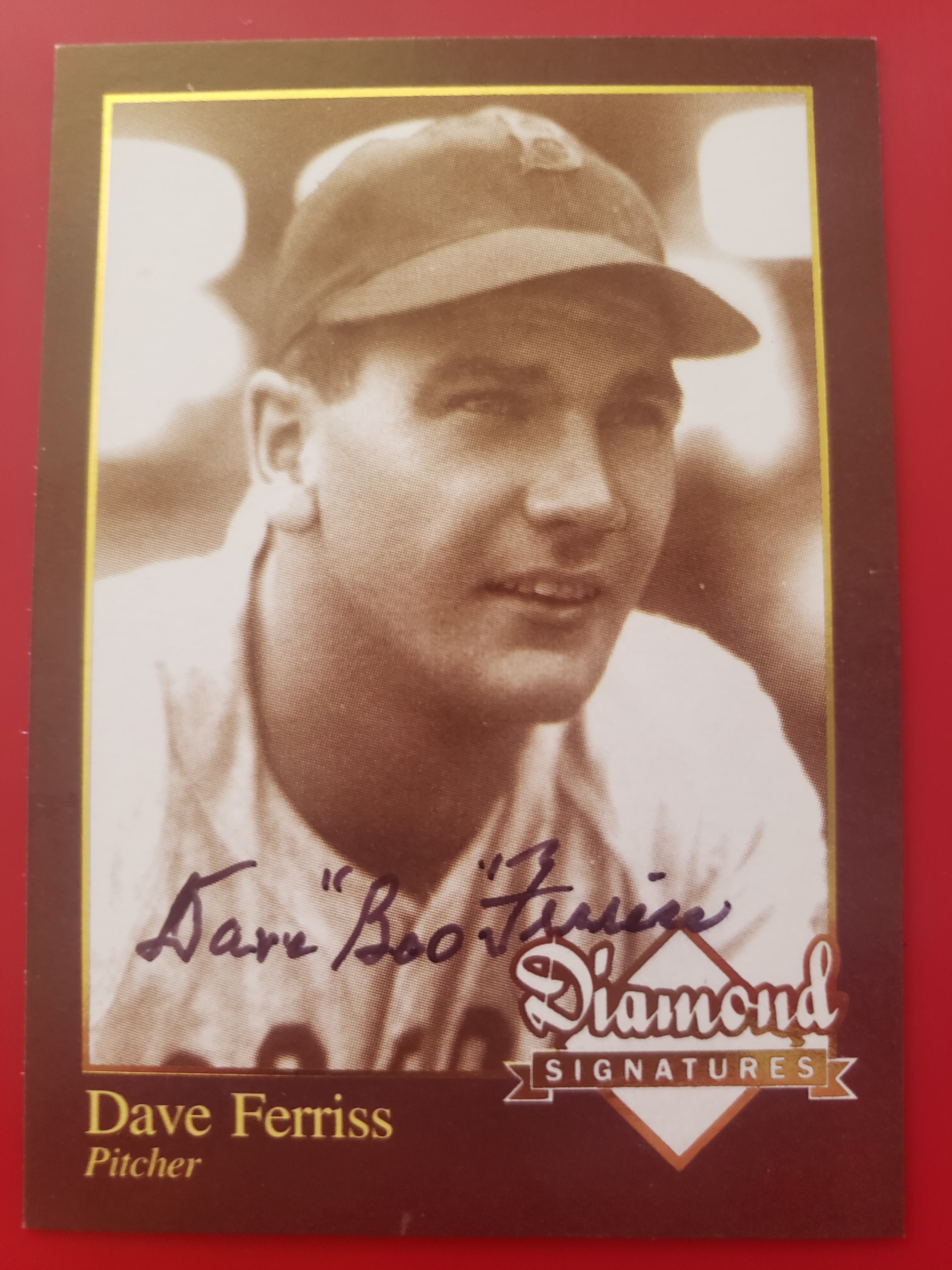
This is a Diamond Signatures autographed card of Ferriss, released in 2006.  This set had a number of autographed cards of players from the 1940's.  I may have to grab a couple more, particularly the Mel Parnell.

Ferriss was signed as an amateur free agent by the Red Sox prior to the 1942 season.  He spent that year in the minors and showed some promise.  He spent the next two seasons in military service then made it to the big leagues in 1945.  That year he turned in one of the best rookie seasons by a Red Sox pitcher ever.  Ferriss was an All Star and finished fourth in the MVP race after compiling a record of 21-10 with a 2.96 ERA in 264.2 innings pitched.  

1946 saw Ferriss lead the rotation with a 25-6 record en route to the American League pennant.  His ERA was 3.25 and he struck out 106 batters while walking 71 in 274 innings pitched.  He was an All Star again and finished seventh in the MVP vote.  He pitched in two games during the World Series, going 1-0 with a 2.03 ERA in 13.1 innings pitched.  Unfortunately, pitching that many innings early on in his career caused some major issues with his arm.  He had a 12-11 record with a 4.04 ERA in 218.1 innings pitched.  1948 saw him pitch more out of the bullpen, but he was just 7-3 with a 5.23 ERA.

Ferriss pitched in five games the next two seasons.  He pitched in the Red Sox minor league system until 1952.  He never made it back to the Majors and retired at the age of 30.  Ferriss did not pitch long, but he was a big part of the rotation in the mid 1940's.  He was one of the team's top pitchers in 1946.  

Thursday, February 11, 2016

Forgotten Stars Pt. 9: Tex Hughson and Boo Ferriss

When a team that has as long a history as the Red Sox it is natural to have players who have been largely forgotten. These are some players who simply do not get mentioned anymore or are largely forgotten.

For a brief time period in the late 1940's, Boston had a terrific team that was expected to compete with the Yankees for multiple American League pennants.  Anchored by a star-studded lineup including future Hall of Famers Ted Williams and Bobby Doerr and other stars such as Dom DiMaggio and Johnny Pesky, the 1946 team was favored to win the World Series against the Cardinals.  Lost in that was the fact that the pitching staff also excelled and we simply do not hear as much about those pitchers as the impressive hitters on that team.
Tex Hughson was the elder statesman of the rotation, at just 30 years of age.  Hughson came up to Boston briefly in 1941 before making a big statement with his terrific sophomore season of 1942 when he won 22 games and lead the league in wins, complete games, innings and strikeouts (albeit with just 113, pitchers did not strike out a lot of batters in those days).  In 1943, his record declined slightly but his other numbers stayed relatively constant.  In 1944 he was 18-5 with a 2.26 ERA then missed the 1945 season due to military service.  He came back strong in 1946 though and was 20-11 with a 2.75 ERA and 172 strikeouts.  1947 saw a little bit of a decline and then arm problems derailed him the rest of his career.  Hughson was a three-time All Star.
Dave "Boo" Ferriss won 21 games as a rookie in 1945.  Granted it was a war-time year and the competition was not real strong, but it was still a strong showing.  In 1946, he won 25 games with a 3.25 ERA and 106 strikeouts in 274 innings.  Unfortunately, he also declined sharply in 1947 and then also had arm problems that basically ended his career.  Ferriss was an All Star in 1946. 

Joe Dobson and Mickey Harris also provided some impressive seasons in 1946.  Harris was 17-9 with a 3.64 ERA and Dobson was 13-7 with a 3.24 ERA.  The four pitchers together were one of the best rotations in Red Sox history.

Much of the reason that these players are largely forgotten is the fact that both players declined significantly and were gone shortly after 1946.  Mel Parnell and Ellis Kinder both took over in the rotation when Hughson and Ferriss faltered.  But for one brief period in 1946, Boston had two young 20 game winners leading their rotation.

Tuesday, November 5, 2013

Forgotten Stars Pt. 8: Ellis Kinder

When a team that has as long a history as the Red Sox it is natural to have players who have been largely forgotten. These are some players who simply do not get mentioned anymore or are largely forgotten.
Ellis Kinder was part of one of the greatest trades in Red Sox history.  Kinder had been in the Major Leagues for just two years, despite the fact that he was already 33 when he was acquired by Boston.  The Red Sox sent three spare parts to the St. Louis Browns for Kinder and another player just one day after sending six other spare parts to the Browns for Vern Stephens and Jack Kramer.  Kinder, Kramer, and Stephens were all major parts of the Red Sox core for the next few seasons and none of the players sent to the Browns amounted to much.

Kinder had a good season in 1948 and was a reliable pitcher, going 10-7 with a 3.74 ERA in 178 innings.  But it was his 1949 season that really guaranteed him a spot in Red Sox history.  That season, in which Boston fought down to the wire for a playoff spot, Kinder was one of two reliable pitchers Manager Joe McCarthy had (the other was Mel Parnell).  Down the stretch, Parnell and Kinder started or relieved in almost every game.  That simply does not happen anymore.  When the dust settled, Kinder ended up with a 23-6 record and a 3.36 ERA in 252 innings.  He pitched in 43 games, starting 30.  He lead the league in winning percentage and shutouts and finished fifth in the MVP vote.

In 1950, Kinder began transitioning into the bullpen full-time.  He still started 23 games, but came on in relief in another 25.  His numbers dipped a little as he was just 14-12 with a 4.56 ERA.  But in 1951, he became a bullpen ace.  He was 11-2 with a 2.55 ERA.  He started just two games, coming on in relief in another 61.  He lead the league in appearances, games finished and saves with 14.  His strikeout-to-walk percentage also improved significantly.  Kinder was injured in 1952, pitching in significantly fewer games, but his ERA stayed about the same and he saved four games.  1953 though was another terrific season as Kinder was 10-6 with a 1.85 ERA in 69 games, all in relief.  He lead the league in appearances, games finished, and saves with 27 once again.

After the 1953 season, Kinder's ERA rose a little but he was still an effective bullpen ace.  He was traded after a good 1955 season in which he was 5-5 with a 2.84 ERA.  He pitched for the Cardinals and White Sox before hanging it up.

Kinder was ahead of his time.  There were not a lot of great bullpen pitchers in the 1950's.  Kinder was definitely one of the few. 

Monday, August 26, 2013

Forgotten Stars Pt. 7: Dick Radatz

When a team that has as long a history as the Red Sox it is natural to have players who have been largely forgotten. These are some players who simply do not get mentioned anymore or are largely forgotten.
In keeping with the closer theme, we come to Dick Radatz, who was without a doubt one of the most dominating relievers of all time.  For a few years anyway.  Red Sox fans remember the Monster but by and large Radatz is a mostly forgotten player as the closer role became more and more defined.  The Monster was an imposing presence, 6'6" and 230 lbs. in his playing days.  And he threw hard.

Radatz was converted into a relief pitcher in the minor leagues by his manager Johnny Pesky.  Pesky wanted to turn Radatz into a weapon, and he did.  Radatz made his Major League debut in 1962 and lead the American League in games (62), games finished (53), and saves (24).  Radatz was 9-6 with a 2.24 ERA and 144 strikeouts in 124.2 innings.  Radatz finished third in the Rookie of the Year voting.  The best was yet to come.

In 1963, Radatz went 15-6 with a 1.97 ERA and 25 saves.  He struck out 162 in 132.1 innings.  Radatz was named to the All Star game and was the first pure reliever to make the team.  Radatz finished fifth in the AL MVP voting that season.  In 1964, he was 16-9 with a 2.29 ERA and once again lead the league in saves (29).  He struck out 181 in 157 innings.  He was once again an All Star and finished ninth in the AL MVP vote.  Unfortunately his numbers would decline from this point.

Radatz slumped in 1965, finishing with a record of 9-11 with a 3.91 ERA.  He saved 22 games but only struck out 121 in 124.1 innings.  1966 saw Radatz start the season slowly, saving four games with a 4.74 ERA before being traded to the Indians.  Radatz bounced around to several teams after that, never again reaching the incredible highs of the 1962-1964 seasons. 

For his career, Radatz saved 122 games, 104 with the Red Sox.  He was one of the first pure closers.  Pesky succeeded in turning him into a weapon.     

Wednesday, August 21, 2013

Forgotten Stars Pt. 6: Tony Armas

When a team that has as long a history as the Red Sox it is natural to have players who have been largely forgotten. These are some players who simply do not get mentioned anymore or are largely forgotten.
A Boston Red Sox hitter has lead the American League in home runs 19 times since 1901.  Some of the players who have done this are obvious.  Babe Ruth, Jimmie Foxx, Ted Williams, Carl Yastrzemski, Jim Rice, Manny Ramirez, and David Ortiz have all done it at one point.  But some other players are a little less memorable.  Tony Armas is one of these players.  Armas actually lead the American League in home runs twice during his career.  The first time was in 1981 when he tied in the strike-shortened season with Bobby Grich, Eddie Murray, and future Red Sox teammate Dwight Evans.  The second time was in 1984.  

Armas originally came up in the Pirates organization before establishing himself as a strong defensive right-fielder and power hitter for the Oakland Athletics.  Armas broke out in 1980 when he hit 35 home runs for the A's at the age of 26.  For the next several seasons he was one of the most powerful hitters in the league.  After the 1982 season, Boston sought some more power in their outfield after losing Fred Lynn to the Angels before 1981.  They had a surplus at third base with the development of Wade Boggs and traded Carney Lansford to the A's along with a couple of spare parts for Armas and Lansford.  It was a trade that worked out for both teams.
In 1983, Armas hit 36 home runs and drove in 107 runs but hit just .218/.254/.453.  He also was miscast defensively as a center-fielder, despite his strong arm.  Armas would not be moved from center during his time with the Red Sox due to the presence of the superior Dwight Evans in right and Jim Rice in left.  1983 was not quite the season Boston was looking for, other than the power.  Luckily the best would be yet to come from Armas.
In 1984, Armas had his best season as a Major Leaguer.  He hit .268/.300/.531 and lead the majors in home runs (43), RBIs (123), and total bases (339).  He also lead the league in strikeouts but his power made up for it.  Armas made his second All Star team and won the Silver Slugger award.  He finished seventh in the AL in the MVP vote.  
1985 saw a decline in Armas's overall numbers mostly due to injuries.  His batting line was close to the same as his '84 season, but he hit just 23 home runs and drove in 64.  Armas's days as an everyday player were over.  His 1986 season saw him hit just 11 home runs and he took a seat on the bench when Dave Henderson was acquired.  After the season he was granted free agency and signed with the Angels.  He played three more seasons before retiring.  
Armas did not last long as an elite power hitter, but he certainly had a memorable season in 1984.

Sunday, August 4, 2013

Forgotten Stars Pt. 5: Tommy Harper

When a team that has as long a history as the Red Sox it is natural to have players who have been largely forgotten. These are some players who simply do not get mentioned anymore or are largely forgotten.
It was not that long ago that "Tommy Harper" was the answer to a trivia question.  In 2009, Jacoby Ellsbury broke Harper's 36-year-old single season team stolen base record.  Since Ellsbury eclipsed his mark, hardly anyone remembers that it was Harper who held the team's record.

Harper was a veteran of about ten years before he was traded to the Red Sox in October of 1971 in the deal that sent Ken Brett, Jim Lonborg, and George Scott among others to Milwaukee and brought Marty Pattin and Lew Krausse to Boston as well.  Harper was the rare speedster of that time that also had some pop.  He was a member of the 30/30 club while in Milwaukee in 1970.

Harper was 31 by the time he arrived in Boston and speedy players typically do not age well.  Nevertheless, Harper provided two good seasons.  In 1972, he hit .254/.341/.388 with 14 home runs, 49 RBIs, and 25 stolen bases.  That performance was good enough to garner him a little MVP consideration, he finished 24th in the voting, but it was not his best season in Boston.

In 1973, Harper had what was likely the second best season of his career.  He finished the season hitting .281/.351/.422 with 17 home runs, 71 RBIs, and 54 stolen bases.  That was the season he broke the team record for stolen bases that was previously held by Tris Speaker back in 1911 when he stole 52.  Harper lead the league in stolen bases in 1973, a rarity for Red Sox.

The next season Harper's numbers declined drastically.  Harper's days as a regular were over and he was traded to the Angels for Bob Heise.  He played two more seasons.

Friday, July 26, 2013

Forgotten Stars Pt. 4: Rico Petrocelli

When a team that has as long a history as the Red Sox it is natural to have players who have been largely forgotten.  These are some players who simply do not get mentioned anymore or are largely forgotten.
For a few decades the A.L. single-season home run record for shortstops was held by Rico Petrocelli.  This was well before the days of Derek Jeter, Nomar Garciaparra, and Alex Rodriguez.  For a long time, shortstops just did not hit that many home runs.  Yet Petrocelli hit 40 in 1969.  What is even more odd is that Petrocelli never hit more than 29 home runs in any other season.

Rico Petrocelli arrived in Boston in the mid 1960's, a time when the team's fortunes were down quite a bit.  Petrocelli was a slick-fielding shortstop with some pop, but not a consistent hitter.  He hit .232/.309/.412 with 13 home runs and 33 RBIs in 103 games his first full season.  He played in more games and his power numbers increased the following season.  

Petrocelli would be one of the central players on the 1967 Impossible Dream Red Sox.  The shortstop was named a starter on the All Star team as he hit .259/.330/.420 with 17 home runs and 66 RBIs.  He was also an exceptional defensive player that year.  In the World Series, Petrocelli hit two home runs.

1968 was a bit of a down year as he dealt with some injuries, but in 1969, his numbers exploded.  He hit .297/.403/.589 with 40 home runs and 97 RBIs, having one of the best offensive seasons for a shortstop to that point.  WAR did not exist at that time, but his 10.0 was tops in the league retroactively.  He also walked 98 times, versus 61 strikeouts.  He was an All Star for the second time in his career.

Unfortunately he would never hit quite that well again.  1970 saw him hit .261/.334/.473 with 29 home runs and 103 RBIs.  In 1971, Petrocelli moved to third base due to the acquisition of future Hall of Fame shortstop Luis Aparicio.  Petrocelli continued to play very well on defense.  1971 was also his last big offensive season as he hit .251/.354/.461 with 28 home runs and 89 RBIs.  He would never again hit more than 15 home runs.

Petrocelli played through the 1976 season and was the regular third baseman through 1975.  He made another World Series appearance in '75 and hit .308 with four RBIs.  

Petrocelli had a nice career but largely falls into the good-but-not-great category.  He played 13 seasons and had career numbers of .251/.332/.420 with 210 home runs and 773 RBIs.  But for three seasons, Petrocelli had some of the biggest offensive seasons of any shortstop to that point in history.  He was the rare player who had a lot of power, yet played very well on defense.  It was exceptionally rare for a middle infielder.    

Tuesday, July 2, 2013

Forgotten Stars Pt 3: Frank Malzone

When a team that has as long a history as the Red Sox it is natural to have players who have been largely forgotten.  These are some players who simply do not get mentioned anymore or are largely forgotten.
The Red Sox of the 1950's were fairly forgettable to be honest.  There were not a lot of great players beyond Ted Williams and the teams by and large struggled.  A lot of the players that did play in Boston were largely overshadowed because their teams were so bad.  Such was the case with third-baseman Frank Malzone.

Malzone's career started a little late.  He missed the 1952 and 1953 seasons due to military service or he would have started a few years earlier.  Malzone made his Major League debut in 1955 at the age of 25.  He did not start playing regularly though until 1957, but that year he emerged as a very good player.  Malzone made the All Star game in his first full season as well as winning the Gold Glove, which had just started that season.  Malzone hit .292/.323/.427 with 15 home runs and 103 RBIs, finishing second in the Rookie of the Year voting in an awful vote.  Tony Kubek of the Yankees won it despite playing 26 fewer games while hitting .297/.335/.381 with three home runs and 39 RBIs.  Malzone really should have won it.

Malzone made it into six All Star games and won three Gold Gloves in his career.  He regularly hit 15-20 home runs per season and was a leading run producer for the team.  Malzone finished his career with a line of .274/.315/.399 with 133 home runs and 728 RBIs.  Not exceptional numbers, but fairly impressive for the time period, especially at third base.

Had it not been for his relatively short career, Malzone may have received some Hall of Fame consideration.  However he only played nine full seasons and was basically washed up at the age of 36.  But given the dearth of third basemen in Cooperstown, he may have been able to get some votes had he played a few years longer.

Tuesday, June 4, 2013

Forgotten Stars Pt. 2: Dutch Leonard

When a team that has as long a history as the Red Sox it is natural to have players who have been largely forgotten.  These are some players who simply do not get mentioned anymore or are largely forgotten.
Quick trivia question.  Who holds the record for the best single-season ERA?  It is not Sandy Koufax or Bob Gibson or Cy Young or Walter Johnson.  It is Dutch Leonard who pitched to a 0.96 ERA in 1914 for the Red Sox.  Yes, you read that correctly.  0.96.  That is insane.

Leonard pitched for the Red Sox from 1913 to 1918.  His career ERA with the Red Sox was 2.13.  That is simply incredible.  1914 was his best season as he went 19-5 and struck out 176 in 224.1 innings.  WHIP was not a statistic at the time but his was an outstanding 0.886.  

Leonard was part of an amazing pitching staff that included the likes of Babe Ruth, Carl Mays, Rube Foster, and Ernie Shore.  It was an incredible pitching staff and Leonard had some of the biggest success.  

Leonard was part of the big Boston fire sale to the Yankees as he was sent to New York along with Duffy Lewis and Shore for a bunch of spare parts.  But Leonard never played for the Yankees, being sold to the Tigers a few months later after holding out.  Leonard finished his career with the Tigers but never had quite the success he did in Boston.

Sunday, May 5, 2013

Forgotten Stars Pt. 1: Bill Werber

When a team that has as long a history as the Red Sox it is natural to have players who have been largely forgotten.  These are some players who simply do not get mentioned anymore or are largely forgotten.
(As much as I would love to, I do not own this card)
Boston's fortunes were beginning to change after 1932, the lowest point in team history.  Tom Yawkey had bought the team and was beginning to sink money into it to try to become competitive.  Just over three months after taking the reins, Yawkey bought some players from the Yankees.  Players coming over from the Yankees had generally not performed well in Boston, but this time it worked out.  Yawkey purchased former star George Pipgras and up-and-coming third baseman Bill Werber for $100,000.00 or $25,000.00 less than the Yankees paid former owner Harry Frazee for Babe Ruth.

Werber was no Babe Ruth but he was a very successful third-baseman for the Red Sox for a few years.  As a 25 year old rookie he hit .259/.312/.379 with three home runs and 39 RBIs but stole 15 bases.  He had the best season of his career in 1934 hitting .321/.397/.472 with 11 home runs, 67 RBIs, and a league leading 40 stolen bases.  

Werber would go on to have two more largely successful seasons as the Red Sox third-baseman and lead the league in stolen bases again in 1935.  Werber was then dealt to the Athletics for Pinky Higgins.  

Werber arrived in Boston at a time that fans were desperate for someone to root for.  He was a good third-baseman who possessed a lot of speed.  He was largely forgotten even at the time because Yawkey was busy picking up star player after star player.  The team went from cellar dwellers to the home of future Hall of Famers Lefty Grove, Joe Cronin, Jimmie Foxx, and Rick Ferrell.  But Werber was one of the first pick-ups to make an impact, acquired just three days after Ferrell.